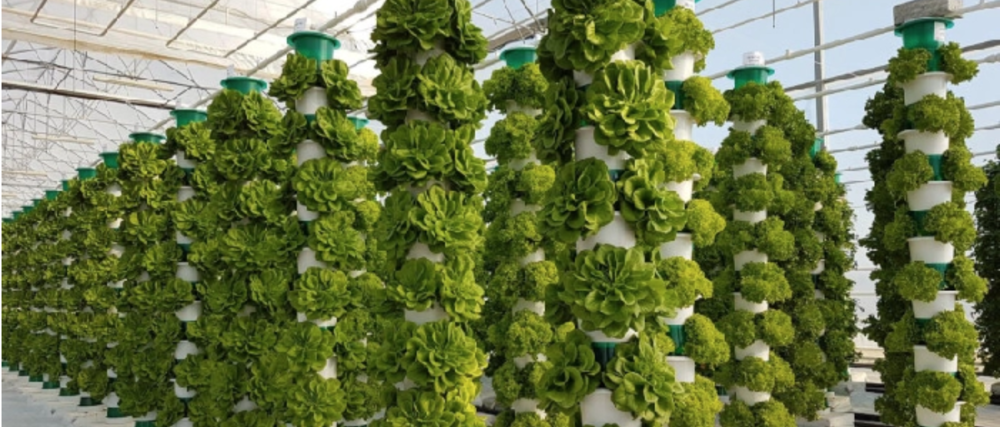
Vertical farming is the practice of growing crops in vertically stacked layers. It often incorporates controlled-environment agriculture, which aims to optimize plant growth, and soilless farming techniques such as hydroponics, aquaponics, and aeroponics. Some common choices of structures to house vertical farming systems include buildings, shipping containers, tunnels, and abandoned mine shafts. As of 2020, there is the equivalent of about 30 ha (74 acres) of operational vertical farmland in the world.
The modern concept of vertical farming was proposed in 1999 by Dickson Despommier, professor of Public and Environmental Health at Columbia University. Despommier and his students came up with a design of a skyscraper farm that could feed 50,000 people. Although the design has not yet been built, it successfully popularized the idea of vertical farming. Current applications of vertical farmings coupled with other state-of-the-art technologies, such as specialized LED lights, have resulted in over 10 times the crop yield than would receive through traditional farming methods.
Urban Farming is growing or producing food in a city or heavily populated town or municipality. Urban agriculture is often confused with community gardening, homesteading or subsistence farming.
Urban farming, also known as urban agriculture is a way for urban dwellers to grow their own food, or at least have access to local food. You get fresher, healthier food—herbs, vegetables, and fruits—and are more likely to eat what’s in season when you eat what’s produced on an urban farm.
Understanding the critical and essential nutrition that human bodies need on a daily basis is very important, and should be focused on more by horticulturist and dietitians. The essential food and diets pyramid below shows clearly what our food should consist of.
Healthy Food and Diet Pyramid – 2026
Join the THOR mission to bring food security to humanity.